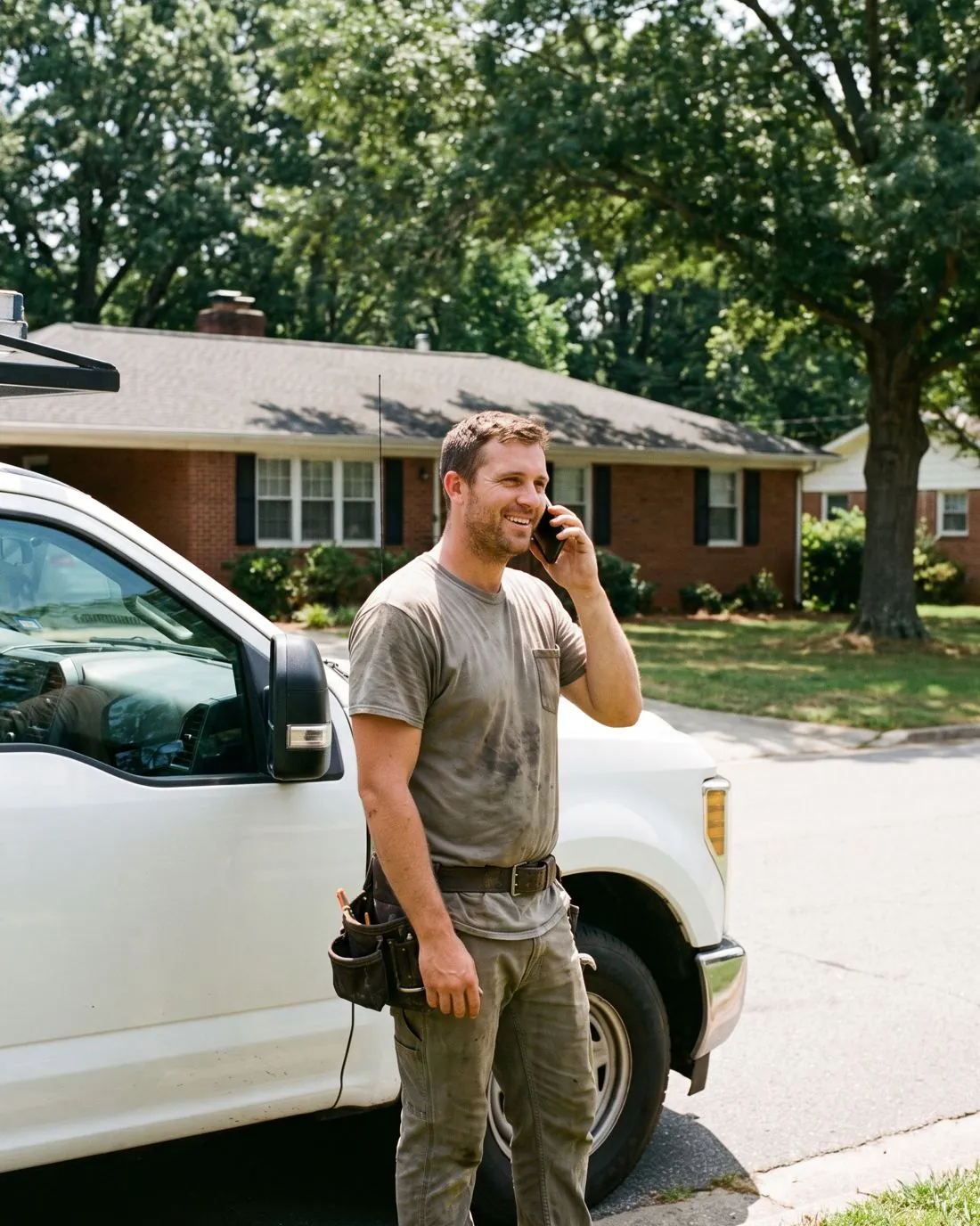
What separates a local roofer's site from the storm chaser's landing page
The good roofing websites do ten things, and most of them are plain. The first screen names your towns and the phone rings from a button. Repair and replacement get separate paths. There's a calm storm damage page, an insurance page that promises nothing it shouldn't, photos of roofs you actually put on, a page for each material, and proof you'll still be in business when the warranty gets tested.
After hail crosses south Charlotte on a Tuesday, half the neighborhood searches "roof repair near me" by Wednesday, along with every out-of-town crew that follows the weather. The roofer who gets those calls shows, in about five seconds, a local company with a phone that gets answered. We design contractor websites across the Carolinas, and this is the list we work from.
1. The first screen says what, where and how to call
Roof repair, replacement, and gutters or siding if you do them. The towns you actually work. A call button and a short form for an inspection or estimate. On a phone the call button is one tap. Someone staring at a water stain over the kitchen table isn't reading three paragraphs first.
2. Repair and replacement are two different visitors
The leak over the kitchen needs someone this week. The 20-year-old roof is a planned purchase, and the homeowner will collect quotes for a month. Same site, two moods.
Repair pages are about speed and stopping damage. Replacement pages help a person decide. Materials, what moves the price (size, pitch, tear-off, decking repairs), how long the job takes, and what install day looks like with a crew in the driveway.
3. Storm damage gets its own calm page
After hail or a wind event, people search for storm damage, hail damage and wind damage by name. One page that explains what to look for from the ground, what to do first, and how an inspection works helps you show up for those searches and helps the homeowner think straight.
Keep the tone level. Urgency and fear read like the out-of-town crew.
4. Insurance explained carefully
Many replacements run through a claim, and most homeowners have never filed one. The good sites walk through it in plain language. What an inspection involves. How a claim usually moves. What your company handles and what it doesn't. That the deductible is the homeowner's to pay.
Whatever your page says about deductibles and claims gets checked against the current rules in both states before it goes live.
5. Photos of roofs you put on
Roofing is visual, and the camera is already in the crew lead's pocket. Finished roofs from the street. A drone shot. Close-ups of flashing, ridge vents and step flashing against a chimney. Each one labeled with the town and the shingle line.
Before and after pairs only when both photos are the same roof. A stock photo of a smiling man on a ladder builds no trust, and a mismatched pair destroys it.
6. A page for each material
Homeowners compare. A page per material you install helps them decide and gives Google something to rank.
- Architectural shingles
- Metal roofing
- Flat or low-slope roofing, if you do it
- Tile or slate, if you do it
Say who each one suits, how long it tends to last, and what pushes the price. If you're in a manufacturer program, name it on the material page it applies to.
7. Trust signals a homeowner can check
A roof is one of the largest checks a homeowner writes. The good sites make the trust case up front.
- Google reviews with names and dates
- Your license number
- Insurance, stated plainly
- Workmanship warranty and manufacturer warranty, explained separately
- A street address or a real service area, so people know you'll be reachable after the final payment
Thin on reviews? How to get more Google reviews covers the text to send and when to send it.
8. Financing where the sticker shock is
If your company offers financing, it belongs on the replacement page and the home page, not three clicks down in a footer. A monthly figure keeps a homeowner from closing the tab when the full price lands.
9. Town pages that say something
If you cover Charlotte, Gastonia, Rock Hill and Concord, a page for each helps you show up in each. Only if every page is actually about that town. The age of the houses, the HOA color rules in a neighborhood you've worked, a job you finished nearby last spring.
The same 400 words with the town name swapped in helps nobody. Local SEO for contractors has the longer version.
10. Fast on a phone
Google indexes the phone version of your site first (mobile-first indexing, in Google Search Central's words), and the homeowner is on a phone in the driveway looking up at the damage. Test on cellular data, away from the office Wi-Fi.
The ten-second check
Pull up your site on your phone.
- Call button in the header of every page
- First screen names what you do and your towns
- Separate repair and replacement pages
- A storm damage page
- Insurance language checked against current NC and SC rules
- Photos of your own roofs, labeled
- A page per material
- Reviews with dates on the home page
- License number and insurance mentioned, financing too if you offer it
- Loads on cellular before the homeowner gives up
Several misses, and the site is the first thing to fix.
Roofing website examples
Where our own proof stands
Our published case studies are hardscape, concrete, fencing, painting and tour businesses. No roofer yet. The contractor case studies show the same first-screen pattern, and the HVAC version of this list is in what the good HVAC websites share.
FAQ
What makes a good roofing website?
A one-tap call button, a first screen that names services and towns, separate repair and replacement paths, a storm damage page, insurance language that has been checked, photos of your own roofs, a page per material, reviews and a license number, all loading fast on a phone.
How much does a roofing website cost?
With us, $399 designs and launches up to five pages, $60 for each extra page, then a monthly plan from $199 that covers hosting, SSL, updates, basic SEO and your Google Business Profile. The roofing website design page has the plan details.
Should a roofing website show prices?
Exact prices are hard because every roof is different. Explaining what moves the number (size, pitch, material, tear-off, decking) helps the homeowner and makes the quote feel fair when it arrives.
See your roofing homepage before you pay for it
We design the first screen for your company before any invoice. Nothing goes live and nothing is billed until you approve it. Design my free mockup. Call (980) 983-7429.
Monday to Friday, 9 to 5 Eastern. Our AI receptionist answers, takes your details, and the team calls you back.